
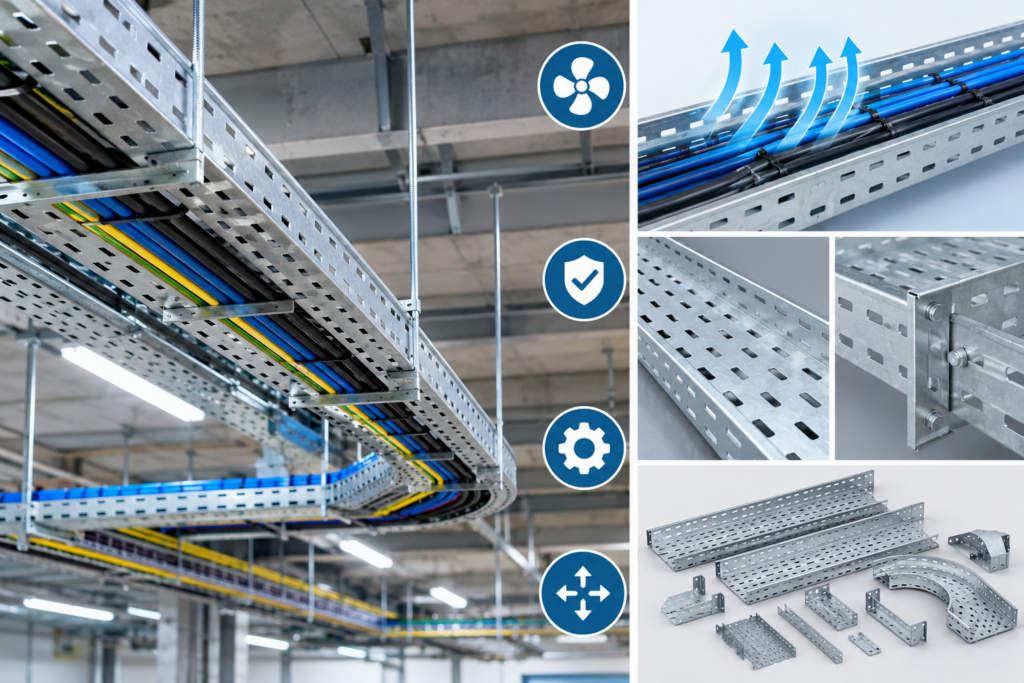
Electrical installations are more than just wires and cables; they also need some sort of organised support that allows cables to be protected, makes maintenance easier and ensures technicians have access to work safely. Are you a business owner, network engineer, electronic technician or infrastructure manager searching for a cable support solution for your data centre, manufacturing plant, commercial property or industrial installation? If so, you might want to look into perforated cable trays; these are a type of cable support that is ideally suited to keep your cable support system organised, well-ventilated and accessible. Perforated Cable Tray Manufacturers in Chennai that you can rely on will have a solution for your project requirements, supporting your installation and electrical network. To assist in your decision-making, here are the advantages of using perforated cable trays.
A well-organised cable system is the foundation of safe and efficient electrical infrastructure.
Perforated cable trays are beneficial in large-scale installations because of their ability of the device to keep electrical cables organised. Cables are typically installed throughout a large production facility to connect the building to the distribution panels, machinery, control rooms, and various sections of the building. Without a cable support system, cables can become tangled, lose track of which circuit they are connected to, or be improperly exposed to physical damage.
Using perforated cable trays, the system can route power cables, control cables, and some communication cables, depending on the circumstances, in a more predictable fashion. This structure allows technicians to keep cables in separate groups when necessary and makes them easier to trace when doing a visual inspection. This is a very practical feature for industrial facilities where the electrical network may grow as production equipment and building automation systems are installed.
Heat is a factor that should be considered for all electrical installations. Conductors can be heated when conducting load current, and the excess heat can damage the insulation, reduce the lifespan and deteriorate electrical performance. Proper ventilation from perforated cable trays can assist in ventilation, but the effectiveness of this depends on the loading, spacing and environment, among other variables. Perforated trays still require careful consideration of the cooling capacity of cable ampacity and grouping, ambient temperature, and appropriate standards for installation.
Cable trays need to carry the weight of the cabling while remaining secure over many years. The load-carrying strength of a perforated cable tray depends on the material, sheet thickness, width of the tray, side heights, spacing of supports and the quality of construction. The most popular perforated cable trays for industrial and commercial applications are steel, as they will provide consistent mechanical support if designed correctly. A galvanised finish can provide a level of protection from corrosion and, in some cases, stainless steel trays are also suitable for some environments. Aluminium trays can be used where weight and corrosion are considerations.
In assessing a tray system, project teams should consider more than how it looks.
Also Read This: Can Ladder Cable Trays Be Modified for Future Cable Expansion?
Every project has its own configuration, volume of cables and environmental factors. An office block may not require the same tray system as a factory that needs a more heavy-duty specification. Perforated cable trays come in varying widths, depths, material types and finishes, enabling the project team to select a configuration that best fits the intended installation. They can be used within the design of commercial or industrial buildings, workshops, warehouses, hospitals, university campuses and utility plants. They are often mounted on walls, underneath suspended ceilings, above the additional space of a suspended ceiling, and in service corridors.
As well as being suitable for different groups of cabling, they can be used within a wider cabling layout provided the correct electrical installation methods, including separation of power and sensitive data cabling, are followed. For example, a project may call for separate cable trays for communications and power cabling to minimise electromagnetic interference. Planning for the number of cables, additional future cables, the space available and accessibility for maintenance when choosing a tray size will prevent excessive overcrowding and make future changes easier.
Installation time can impact the sequence of work, the total number of labour hours needed and the lifetime costs of maintenance. For this reason, some practical attributes of perforated cable trays can make electrical installation easier when considered early in the project design stage. Nonetheless, the process of installing a cable management system may not be different depending on the project, site conditions and access, the size of the cable tray system and the type of accessories available to the installer. It is important to install the necessary supports, strong joints, appropriate edge protection and correct bonding or earthing connections where needed, as well as inspection points.
Important installation and maintenance benefits include:
The purchase price is just one aspect of the total cost of the cable tray installation. A more meaningful evaluation takes into account installation labour, accessories, maintenance needs, long-term working life and potential future modifications. For perforated cable trays, the accessible design makes inspection and routine maintenance easier, potentially bringing long-term benefits. With the appropriate tray material and protective finish, the system can also deliver reliable performance in the appropriate working environment.
Several factors influence the total project cost:
The performance of a cable tray system depends not only on its design but also on the quality and suitability of the product supplied. Working with an experienced manufacturer can help project teams identify appropriate options for their electrical infrastructure requirements. It is also useful to confirm applicable standards, testing documentation, and project-specific requirements before finalising a purchase. Where installations involve outdoor exposure, chemicals, moisture, or elevated temperatures, the manufacturer should be able to clarify whether the proposed material and finish are suitable.
Before placing an order, consider whether the manufacturer can provide the following:
Smart cable management today creates simpler maintenance and greater flexibility tomorrow.
Perforated cable trays are an effective blend of cable organisation, ventilation, ease of maintenance, structural strength, and installation versatility. Their appropriateness for any construction project is based on selecting the appropriate material, size, loading capacity, and finish suitable for the environment where they will be used. Proper planning can guarantee that there is enough space for cables, proper support, and allowance for future expansion. In selecting good Perforated Cable Tray Manufacturers in Chennai, electrical engineers should concentrate on quality, specifications, applicability, and supply.
© 2025 SSD Energies | All Rights Reserved | Developed By
