
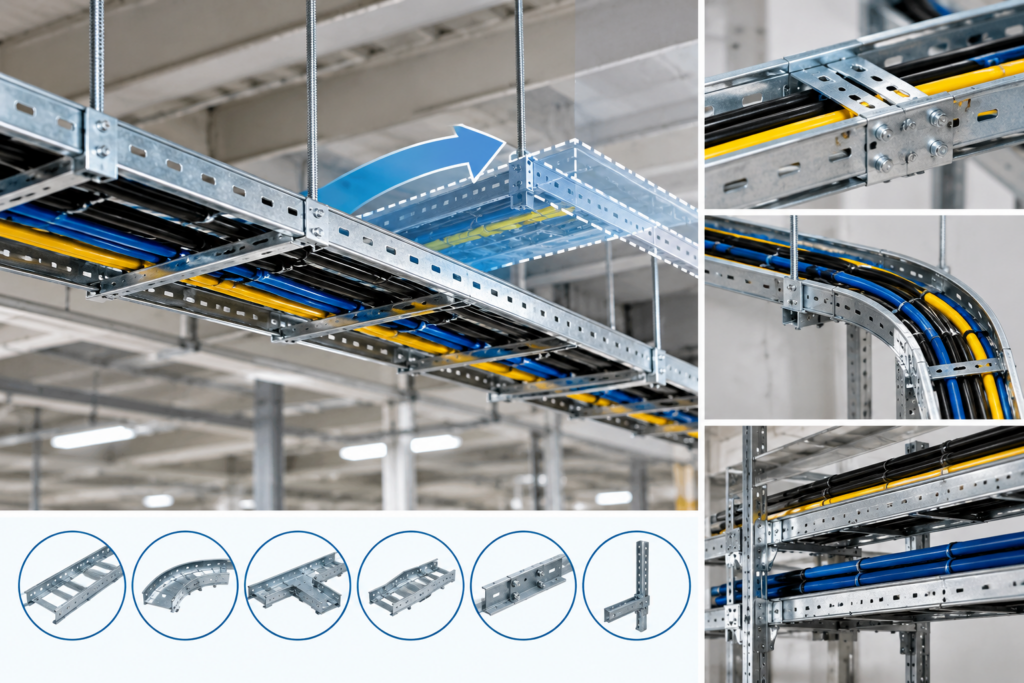
Electrical systems aren’t static over the course of a couple of years. Businesses are growing, factories are adding machines to production lines, offices are placing more workstations, and data centres are installing more network connections. Businesses are expanding, factories are bringing in new machines to production lines, offices are adding more workstations and data centres are installing more network connections. The changes can contribute to a growing integration of power cables and communication cables within a facility. This puts project engineers and facility managers in a unique situation, asking if it’s possible to adapt current ladder cable trays to accommodate future cable growth.
In most cases, ladder cable tray systems can be easily adapted or extended to accommodate more cables without compromising on load capacity, space requirements, or installation conditions. Professional Ladder Cable Tray Manufacturers in Chennai could generate a business cable management programme in a manner that will take care of their future electrical demands without the need for a total replacement of the system. Any changes, however, are best examined for their long-term reliability, mechanical stability, and electrical safety.
Let’s dive into this blog to explore the important factors to consider before modifying an existing cable tray system.
“A well-designed cable tray system creates room for growth without compromising safety.”
Future power requirements are an important part of the infrastructure development that is planned for industrial infrastructure. When a requirement for extra cables, machines or communication networks is added, a system designed for the present requirements can be troublesome to manage.
Considering future expansion during the initial design stage offers several advantages:
Ladder cable trays have a regularly spaced ladder that is set up between two side rails with cable attached. Their open design allows them to be used in many industrial cable management uses, such as power distribution, control systems, and some communication systems. This is dependent upon the type of installation layout, cable requirements, clearance available and mechanical loading. Modifications should use compatible components and approved connection methods rather than improvised extensions. There can be a few ways to do the modifications depending on the current installation.
Common modification options include:
Before routing around and over a ladder cable tray, you should determine the condition, size and capacity of the existing tray, as well as its suitability for use with another cable or wire. Take these factors into account:
Also Read This: 8 Cable Tray Features You Should Check Before Buying
The addition of another tray section is not enough for successful expansion. The new components have to be compatible with the current system and suitable for the working environment. In cases where moisture, chemicals or corrosive circumstances are unavoidable, such as outdoors or in industries, material selection is especially vital. Welding to incompatible metals or the use of inappropriate coatings could exacerbate the rate of corrosion at connections. In choosing components from Ladder cable tray suppliers, take into account the following specifications:
Modifying an existing cable management system can present practical challenges, particularly in facilities where electrical installations are already operating. A careful inspection helps determine whether extending the current installation is practical or whether a new route would offer better long-term use.
The decision to modify an existing ladder cable tray depends on its condition, available capacity, and future requirements. Not every expansion requires a complete replacement, but extending an unsuitable system can create unnecessary risks.
|
Situation
|
Recommended approach
|
|---|---|
|
The tray has sufficient spare capacity and is in good condition
|
Consider extending the existing route after technical verification.
|
|
The tray is nearly full but structurally sound
|
Assess a wider section, a separate tray, or an additional tray level.
|
|
Upgrade the support arrangement or redesign the affected section
|
|
|
The tray has extensive corrosion or deformation
|
Evaluate replacement rather than adding more load.
|
|
New cables require different routing or separation
|
Consider a dedicated route designed for the new circuits.
|
|
Future expansion is expected to be substantial
|
Develop a revised cable management plan with reserved capacity.
|
Future-proofing begins with an accurate understanding of the facility’s current and anticipated electrical requirements. Rather than choosing a tray based only on the number of cables needed today, engineers should consider planned equipment additions, building extensions and network upgrades. Consulting experienced ladder cable tray manufacturers during project planning can help identify suitable configurations, compatible accessories, and practical expansion options. The final design should be reviewed by qualified electrical or structural professionals as appropriate.
A practical expansion plan should include:
“Every cable tray modification should balance flexibility, structural strength, and electrical safety.”
Ladder cable trays can be easily adapted for various future electrical and communication needs, which makes them useful for the growth of industrial and commercial structures. But there are things such as the conditions of the load, space restrictions, structure, cable routing and compatibility of the existing tray with the new component parts that must be considered in successful expansion. When determining if existing installations should be extended, upgraded or replaced, businesses should consider these variables. Collaborating with dependable Ladder Cable Tray Manufacturers in Chennai can facilitate project teams in selecting suitable parts and designing cable administration frameworks that are consistent with long-term success and security, as well as enabling future growth.
© 2025 SSD Energies | All Rights Reserved | Developed By
