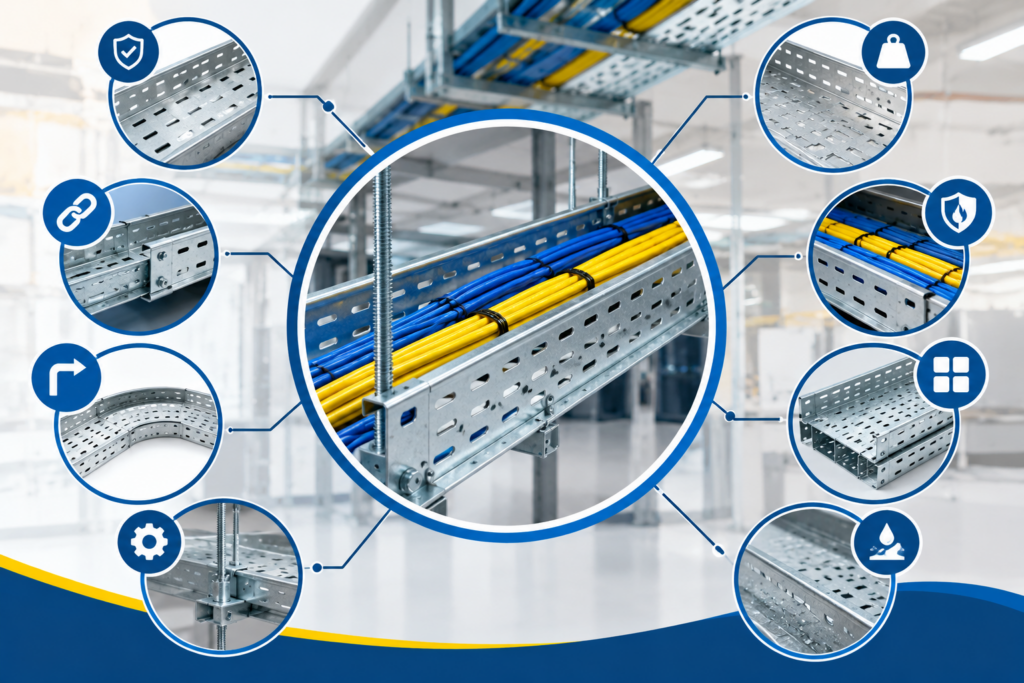
8 Cable Tray Features You Should Check Before Buying

Cable Tray Manufacturers in Chennai

“Good cable management begins with choosing the right support system.”

A cable tray may look like a simple metal structure, but the right one can make a major difference to the way an electrical system is installed and maintained. The tray needs to carry cables safely, fit the available space, handle the expected load, and remain suitable for the surrounding environment. Details such as material, width, ventilation, surface finish, and resistance to corrosion can easily be overlooked when comparing products. In this blog, we will explore 8 cable tray features you should check before buying and understand why each one matters when planning a reliable cable management system. Comparing products from experienced Cable Tray Manufacturers in Chennai can also help you find options that match your installation requirements.

Check the Tray Material

The strength, durability, weight, and adaptability of the cable tray directly depend on the material used in the manufacturing process. A tray set up inside might need different requirements than a tray set up outside in the rain, humidity, chemicals or changing temperatures. Depending on the specific conditions, selecting the right material can enable the cable support system to operate effectively in the long term.

Some key factors with regard to materials are:

  • Material type: Ensure the tray is constructed of an appropriate material such as suitable steel or aluminium or other approved material.
  • Structural strength: Does the material have structural strength to accommodate the expected cable setup?
  • Environmental suitability: Match materials to indoor, outdoor, industrial, or commercial conditions.
  • Thickness of the materials: If necessary, the thickness of the materials can contribute to the rigidity and durability of the overall product.
  • Application requirements: Select the appropriate type of material according to the load and environment of the application site.

Look at Load Capacity

Cable trays should be able to carry the loads in them without them bending or deforming excessively. This capacity is determined by the number of cables, size and weight of cables, spacing of cable supports and whether more cables will be required in the future. It may be helpful to see what the load is before buying it to prevent problems after installation.

The load capacity should be based on the following:

  • Cable weight: Estimate the total weight of the cables that will pass through the tray.
  • Support Spacing: Inspect the tray between the points of support for behavior.
  • Future additions: Reserve the possibility to increase cable number if needed (over time).
  • Tray strength: Ensure that the strength of the tray can withstand the expected load.
  • Installation conditions: Take note of if the tray will be exposed to vibration or some other mechanical load.

Choose the Right Tray Width

The width of the tray is more than just a matter of fitting all the cables in. Enough space for proper arrangement, installation, inspection and changes to come. One that is too narrow could lead to congestion, and one which is too wide could be wasteful in space and material.

The width can be based on:

  • Space for cable: Get the space needed for cables being installed.
  • Cable diameter: Consider the combined size of the cables rather than their number alone.
  • Future expansion: Leave practical room for additional cables where required.
  • Available route: Ensure that the width of the tray will allow for the specified route.
  • Maintenance access: Do not overload the tray, allowing easier access to cables.

Consider Cable Separation

Depending on the type of cable, they might have to be placed with a certain degree of care in the same electrical installation. Power, control, communication and signal cables may require different specifications and correct routing may make identification and maintenance easier. Separating the cables also helps to make a tidier and more organized installation.

Cable set-up can include:

  • Power cables: Organize high power cables as per the installation requirement.
  • Control cables: Ensure proper routing for control circuits of lower voltage.
  • Separate signal cables: Separation is considered if sensitive signal wiring is present.
  • Communication cables: Make certain data-related cables are kept neat and clear of any unnecessary interference.
  • Grouping: Bundle similar cables together for future easier traceability and maintenance.

Check Corrosion Resistance

Cable trays used in humid, outdoors, coastal or industrial settings can have conditions that may gradually impact unprotected metal. Surface protection is important in product selection as corrosion can make the tray weak and decrease the service life. Level of protection will vary according to environment in which the tray is to be installed.

Corrosion protection can consist of:

  • Coating with zinc: Steel can be protected from corrosion by applying a layer of zinc.
  • Powder coating: Coatings can be used for an additional protection surface that can be used.
  • Environmental resistance: The resistance of some materials is inherent to the environment.
  • Surface protection: Ensure the protected surface is suitable for the operating environment.

Also Read This: The Wire Mesh Cable Tray Advantage Nobody Talks About Until It’s Too Late

Look for Proper Ventilation

Open cable trays may be helpful in installations where heat control is important because it will permit air to flow around the cable. However, if there is proper ventilation, the cable arrangement is more visible and may even make it easier to inspect the arrangement than a completely enclosed system. Still, the necessary tray design should rely on the type of cable and installation.

Ventilation can aid in:

  • Air circulation: Tray designs that are open can provide air circulation around installed cables.
  • Heat management: Improved airflow may help dissipate heat where applicable.
  • Accessibility of cable viewing: Open structures allow easier viewing of the condition of the cable.
  • Inspection: Technicians can detect problems in the cables without opening the enclosure completely.
  • Cleaning: It can be easier to clean and inspect trays regularly when they are open.

Examine Surface Finish

Surface finish is an aesthetic quality and not just that. The right finish can result in smoother edges, enhanced protection from environmental exposure, and a cleaner overall installation. sharp edges or un-smooth areas may cause problems in laying and handling the cables.

The following surface finish should be checked:

  • Smooth edges: The edges of the trays must also be smoothed to minimize the likelihood of damage to the cables.
  • Seamless coating: The protective coatings should be applied uniformly throughout the tray.
  • Appearance: Cleanliness can suggest that the manufacturing control was better.
  • Scratch resistance: The finish should be appropriate for the anticipated usage and conditions.
  • Coating quality: Ensure that the finish is suitable for the interior or exterior environment.

Take into account installation and maintenance

The ideal cable tray is one that can be installed quickly and easily and accessed easily when changes are needed in the future. The sections, bends, joints, supports and accessories on a tray must all cooperate to enable the cable to move in a functional manner. It is better to plan the maintenance when deciding on the type of building so as to avoid unnecessary effort later.

Factors in installation and maintenance are:

  • Easy assembly: Sections of the trays should be easy to assemble during installation.
  • Availability of accessories: Bends, couplers, supports and other accessories should be available that are suitable.
  • Service access: The layout should be designed to enable the technologist to access cables, if necessary.
  • Future modifications: The system should be flexible enough to allow additional routes or cables to be added, where possible.
  • Routine inspection: Tray should be accessible for regular inspection of supports, connections, conditions of cables.

Building a Cable Management System That Lasts

Choosing a cable tray is about more than finding a structure that can hold wires. Material strength, load capacity, tray dimensions, cable arrangement, corrosion protection, ventilation, surface quality, and ease of maintenance all influence how well the system performs after installation. Taking time to compare these details can help avoid unnecessary changes and create a more organised electrical setup from the beginning. By exploring suitable solutions from reliable Cable Tray Manufacturers in Chennai, businesses can select cable trays that match their installation conditions, cable requirements, and long-term maintenance needs.

Frequently Asked Questions

1. What should I check before buying a cable tray?

Consider the tray material, load capacity, width, cable separation requirements, corrosion resistance, ventilation, surface finish, and installation needs before making a selection.

The tray size should be based on the number, diameter, and weight of the cables, along with the available installation space and room for possible future additions.

Cable trays used in outdoor, humid, coastal, or industrial environments may be exposed to moisture and other conditions that can affect unprotected metal. Suitable protective finishes can help improve durability.

Different cable types may have different routing and separation requirements. Power, control, communication, and signal cables should be arranged according to the design and electrical requirements of the installation.

Look at the manufacturer’s material quality, tray designs, load specifications, finishing standards, available accessories, customisation options, and installation support. Comparing these factors can help you identify a solution suited to your project requirements.

Welcome to SSD Energies, one of the top Cable Tray Manufacturers in Chennai where we provide reliable and innovative solutions for cable management and electrical installations. We provide a variety of options, such as Laser Cutting Services in Chennai, ladder trays Perforated Cable Tray, Wire Mesh Cable Tray, Ladder Cable Tray, Electrical Cable Tray in Chennai.

© 2025 SSD Energies | All Rights Reserved | Developed By seo company in chennai